Follow the music
Who shaped Frank Zappa—and where did his influence go?
Drag artists. Zoom around. Tap an artist or connection to see its details.
Open full screenThe original research graph: relationship labels and confidence scores from that experiment. It includes influences, teachers, and collaborators; the detail cards do not contain source citations.
The recommendation engine I wanted
Why no Edgard Varèse for Frank Zappa? Chuck Berry for the Rolling Stones? These were the real revelations: steps into another time and often another genre.
The frustration
came first
In March 2023, I sent my friend Ronan a music recommendation map and complained that I wanted a map based on influence, rather than shared listeners. I had asked ChatGPT for help and it had pointed me back to existing recommendation engines. That was the problem I was trying to get past.
Ronan described how reading Zappa's biography had led him to Varèse and Stravinsky, then into opera, ballet, and the music of Boulez and Webern. Those connections had opened doors. He also questioned whether an automated recommendation could capture the excitement of discovering a connection for yourself.
My reply already sketched the approach: organize interviews and biographical sources, look for statements about who an artist listened to and what had an impact, and read those mentions in context. We tried Hüsker Dü too, and Ronan immediately called out maps missing the most obvious connections to Sugar, Bob Mould, and Grant Hart—actual band member projects. A familiar list of related artists wasn't giving us what we wanted.
Start with
the sources
I wanted to see if I could build a tool to harvest the public data for an artist and explore these connections. Throw in a strength signal based on frequency of citations. Visualize it.
Zappa was
the test
I know enough about Frank Zappa to question the results, so he made a useful first test. I asked AI to find the relationships and supply the sources. I was the validator: reading what came back, checking whether it held up, and asking to follow the connections further backward and forward.
It worked very well. The sources were good, the connections were convincing, and there were discoveries I wanted to explore. That result became my benchmark for what the experience should deliver for another artist.
Seeing the
connections
I downloaded Gephi, loaded the artist and relationship files, and had a blast trying different visualizations. A list of names became a network I could rearrange and explore across generations.
We also made an interactive HTML version that I could share with friends. Learning something, seeing it take shape, and passing it along was already a satisfying result. It also gave me another excuse to promote Zappa. Heh.
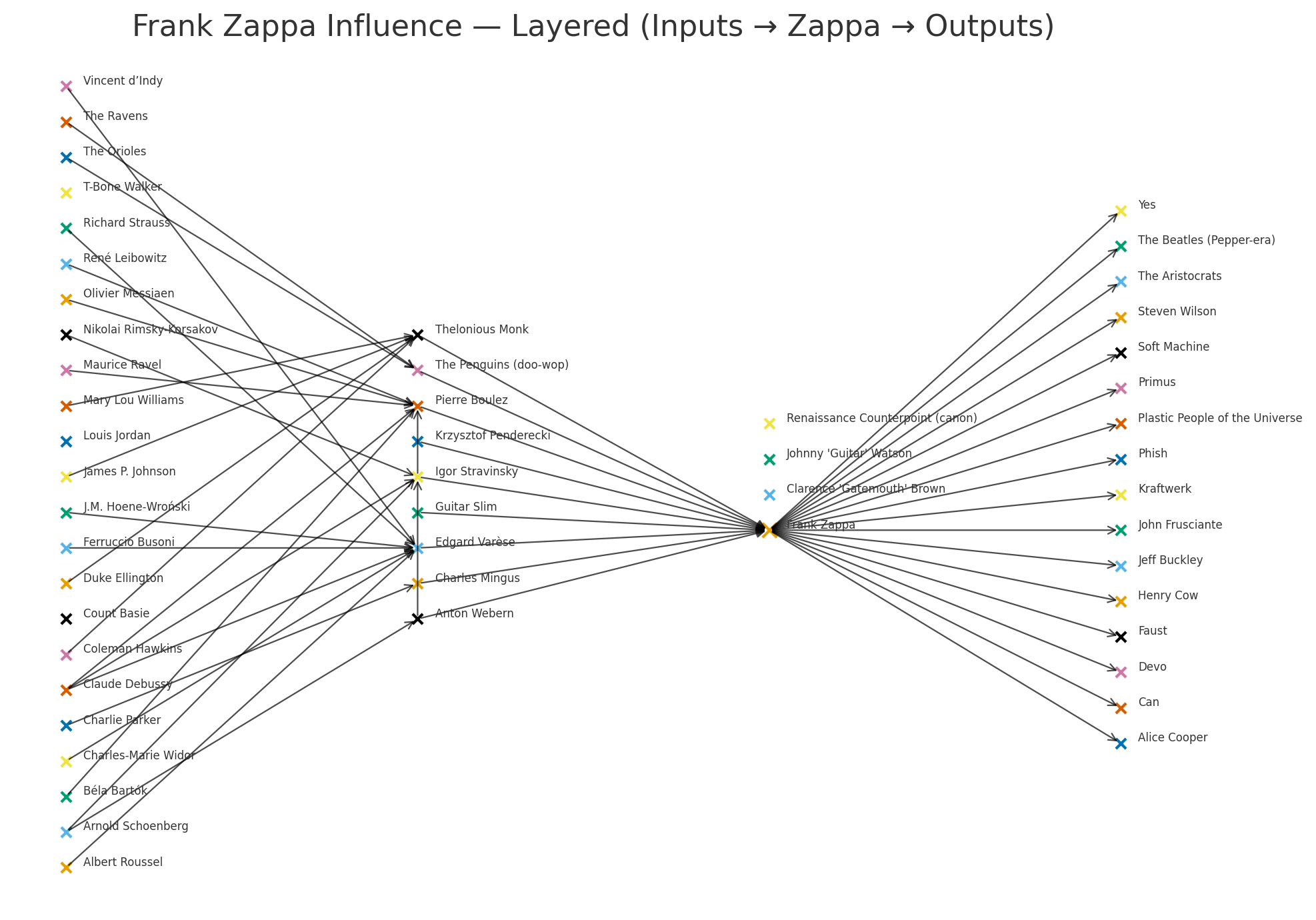
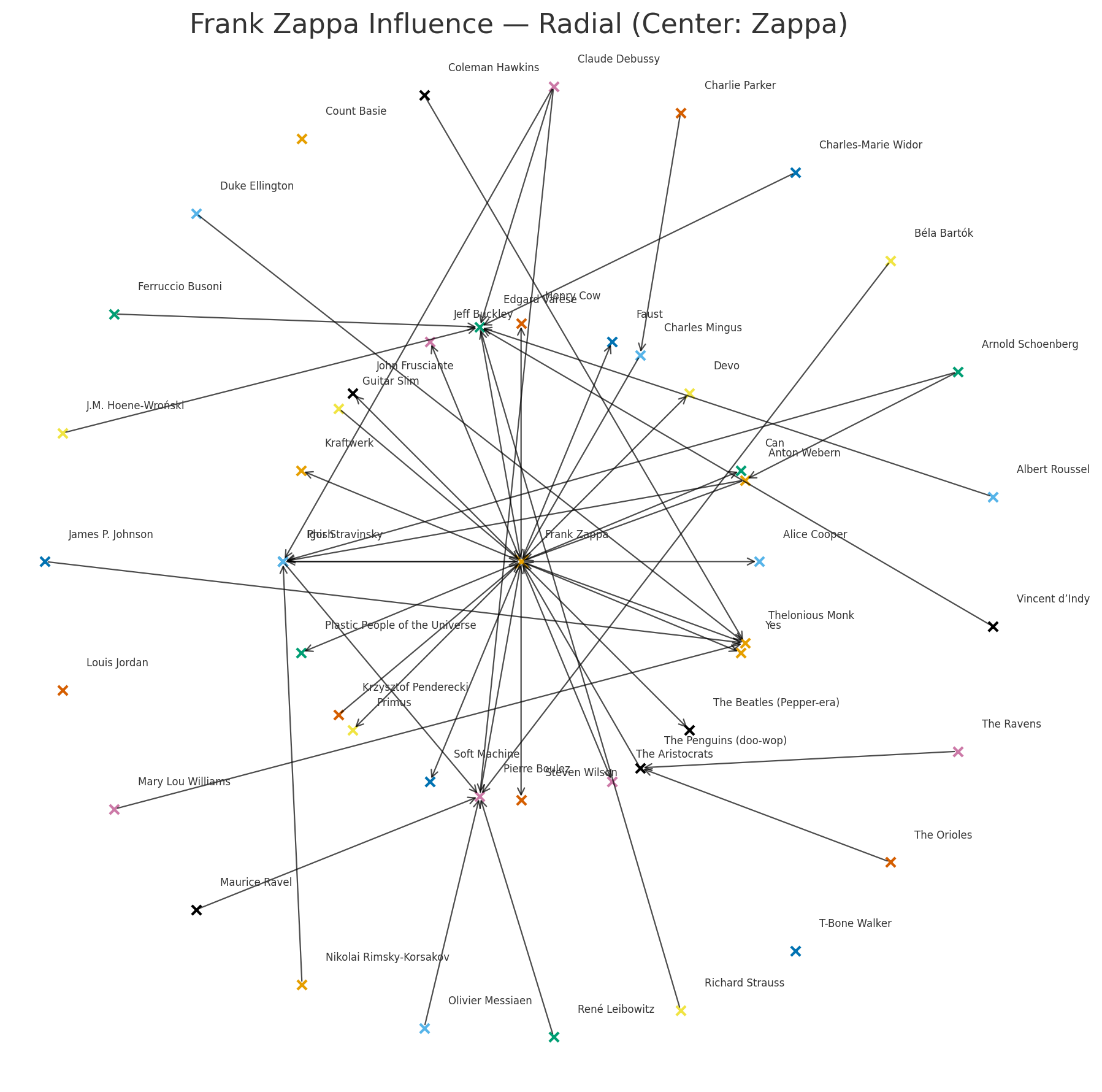
Original research visualizations. The images preserve the network, but don't include its supporting citations.
Getting an app
to run
As the experiment grew into a local app, we added a Spotify playlist workflow. With AI helping me through the setup, I got a server running and learned about authentication, callback addresses, environment settings, and an ngrok tunnel.
That was a learning curve of its own. The tunnel gave the local server a reachable address, but a changed address or mismatched callback could break the connection. Getting the prototype working meant understanding enough of that setup to troubleshoot it.
The separate
Harvester
The next question was how to repeat the quality of the Zappa research for any entered artist. We built a separate Harvester app to collect possible relationships from more sources and feed the results into the main app.
This was where the experiment became frustrating. The expanded datasets brought in too much noise: mentions and associations that didn’t convincingly establish influence. I don’t remember the exact tweak that made it worse, but I remember wanting the original research method back—even if that meant working through one artist at a time.
I also learned what building a database would require: jobs to find material, extract claims, check the evidence, and store the results. Running those jobs somewhere, paying for access where needed, and maintaining the data were part of the project too.
Coming back
to it
Many months later, I returned to the project with different tools available and a better sense of the hard part. Collecting more names was easy to mistake for progress. The useful result depended on preserving why each connection belonged in the graph.
The current demo saves researched connections and lets you inspect their evidence. Zappa, Tony Rice, and Talking Heads provide starting points. The results still need judgment; passing automated checks doesn’t make a claim beyond question. Spotify links are available, while playlist creation remains unfinished in this rebuild.
AI tools have also changed how I think about the experience. I can ask for artist research and help putting a playlist together in a conversation. That makes me reconsider what needs a dedicated interface. The visualization is still the part I enjoy: seeing connections, finding a musical door I hadn’t opened, and sharing it with someone who might enjoy it too.
Explore the current demo