On Revolutions and Robots
Chatbots. The latest “revolution” in my business. We have new revolutions every few months. I work in advertising AND technology. Combine the two and all your problems are solved. That’s what they believe, anyway. I don’t really write about our revolutions, because they come and go about as often as the 7 train to Queens. Sporadically, but reliably. Actually, I don’t really write at all. I just don’t always feel like working. And I got an email today from Business Insider urging me to understand the “Chatbot Revolution.” I’m here to tell you what I think chatbots are, where they are now, where they may be going, and why it’s ok to laugh at it all. But I also think there are very good things to keep in mind about them, most of which I simply ripped off of people smarter than me, who I may or may not reference herein.
What are Chatbots?
Firstly, just because we humans are really good at putting an “I” next to an “A” and displaying the acronym “AI” does not mean we know what the hell we are talking about. I can go on and on about what Artificial Intelligence does and should mean, but you can find that elsewhere. I’ll just use an example.
Most of the 1:1 chatbots I see are funny faces with funny names that offer a lot of canned responses. You pull the string. It says something. They can “listen” for certain phrases or what we call “keywords” in the business. Then they can fetch the proper response. Online ads have been doing this for years. It’s how they work. They listen for your string of personal data, look for keywords, and serve you the right ad. Is that a bot?
Toys that talk go back probably 100 years, but AOL built one of these 1:1 chatbots back in 2001 that took it to the next level and did the whole “listen for keywords” thing. Because you were typing specific words to a thing that manifested itself as a human, suddenly we were in bot land. And suddenly, we saw how dumb they were and how they worked. Match keywords to canned responses. String toys 2.0. I wrote about it and made fun of it back then. I was one snide little shit. You can read all about this AOL chatbot called Smarter Child from my still unpublished book about the first Dot Com boom and bust. Here’s that excerpt. And part two. Puerile stuff to be sure. I’m not so snide and dismissive these days. I’m all ears.
Recently, I had the pleasure of hearing a brief talk given by Phil Libin, co-founder of Evernote and now investing solely in chatbots. You should follow him on Twitter. Here is his list of three qualifying attributes that make a chatbot useful (and potentially an investment):
1. It needs to solve a real problem
OK. As a Product Owner I know that this is a no-brainer for just about anything. No matter how cool and popular that faceswap thingie is right now, it is secondary to the ultimate success of your app/product that hopefully solves a real, larger problem.
2. A chatbot should not be made to simply replace an existing app that already solves a problem unless it does it at least 10 times better
There’s an old adage that if Henry Ford listened to people about how to solve the problem of getting people from Point A to Point B faster, he’d end up only focusing on how to make horses faster. That seems to contradict this point, except for the “10 times” part. A car is more than 10x better than a horse, no matter what you do to it.
3. Stop thinking of bots as people replacements for 1-on-1 conversations. Conversational Interfaces are about bots as bystanders who augment human conversation
This is really why the string-pulling Scarface just can’t be the bot of the future. And this is why we must stop thinking about them that way. Libin said that bots should be R2D2, solving problems arising in conversation. They should not be C3PO, whose unwelcome know-it-allness and poor attempts at exhibiting humanity makes him, well, an asshole.
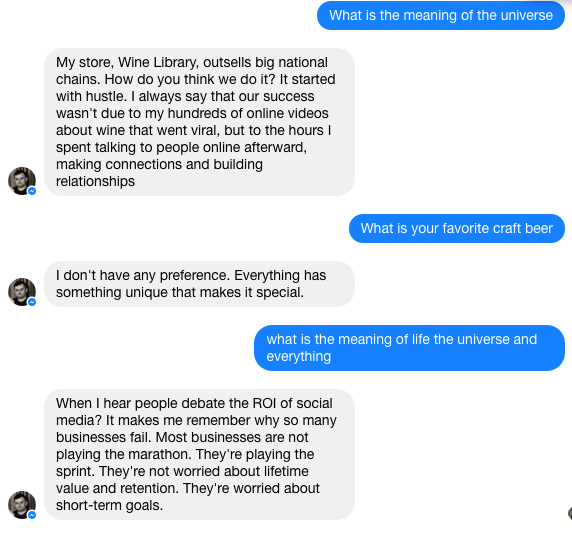
Here is an example from just today that demonstrates how important #3 is. This is Gary Vaynerchuk’s “Gary Vee Bot”:
Now for a couple problems bots absolutely can and do solve, followed by the reservations I have about all of this:
The Good: Chatbots can easily connect you to interfaces you don’t want to go into through interfaces you spend all day in
Technically-focused teams using Slack is a great example of this, and Slack is fertile ground for playing with bots. Let’s say you have certain tasks to do to keep your technology running efficiently. Like many outfits, we use Amazon Web Services (AWS). It comes with an interface. It requires a username and password. It requires a bunch of clicking to get to where you need to go. It requires clicking into a form field and updating stuff and clicking switches and other familiar web interfaces. In Slack I can program a bot to accept text-based parameters (and respect the user authentication) to cut out the time and effort required to go into this other interface. Slack is, after all, staring me in the face all day long.
This isn’t so sexy nor revolutionary. But it solves a (minor) problem. It’s also what makes advertisers salivate and start spouting on about “revolutions”.
The Annoying: If all these millennials are in Snapchat/Instagram/Whatever for 6 hours a day, then that’s where we need to put our branded bots, and that’s where they will respond

The problem here — at least in my admittedly small circles of millennials I observe as almost an anthropologist - is that none of them seem very excited about chatbots interfering with their fun. Back in my day, no one was very excited about banner ads either. Perhaps we’ll just learn to accept them for now. But remember that inviting a branded bot to hang around you and your friends is inviting an ad banner to hang around and collect all your conversations. Does that bother you? If not, then have at it.
The Good: Bots allow developers to bring features to market without having to build front ends
We’re all in conversational interfaces now…all the time. It’s a serious pain in the ass to build apps and expect a bunch of people to understand the problem I am pretty sure I am solving for them (especially when their faces are stuck in Slack all day), and expect them to go get my app, learn a new interface, and see for themselves.
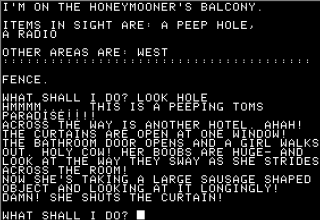
But are these bots just because we invoke them by name? The problem I have here is characterizing every text-based, command-response program that surfaces itself as a bot. There was no “bot” in Choose Your Own Adventure games or books. Below, we have Softporn Adventure, an old favorite from my childhood.
The Inevitable: Bot Management and their interfaces
Today I spoke with some folks who build bots for brands and individuals. Let’s say I want a bot to replace me in some form and I want to just pay someone to do it. I would come up with a list of responses to some keywords and phrases that someone might ask me. I’d come up with conversation starters. I’m never going to get to the point of building my personality or any real intelligence that way, of course. But I could enhance an existing discussion or some type of one-way communication I’ve authored that you may want to know more about. I’m promoting a book. I’m in a movie. I just spoke at a conference about a specific topic. I just released some music or some art. Sure, I could invite you to contact me and maybe I’ll get back to you. But think about this as an addendum to whatever my message is that can appear in whatever conversational interface you use without me being bothered about it…if I am willing to do that.
An agency might want to manage a bunch of bots at once, each with its own command-based responses. An agency might also want that bot to be able to respond to more than those commands. Ask Jeeves. A bot management interface would allow me to connect that bot to difference sources. Sure, my bot might be able to recognize the subject of your question about my book and return a response, but maybe my bot wants to also let you know the weather if asked. So if you were to ask me for the weather, I could see where you are, look up your zip code, and return a friendly weather report also.
What brands and agencies are looking for are interfaces that allow them to manage multiple bots, create and update the personal “intelligence” for each, connect to data sources to increase the breadth of canned responses, and appear on the appropriate channels, be it Facebook Messenger or Slack or whatever conversational UI people can be found who might be interested.
Intelligence? Personality? Maybe a little.
So what’s a useful bot? Show me one
Here is one I heard was exciting and useful. It is called Growbot. It sits in your company’s Slack, waits for someone to spontaneously praise a co-worker, and then barges in to tell everyone that it has “rewarded” that person with “kudos”, which is presumably the KPI here. It’s free. Try it.
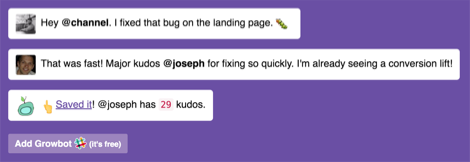
Growbot presumably meets the above 3 criteria:
1. It doesn’t invent a new or fake problem. It purports to solve the real problem of employee evaluation. Employee evaluation sucks, right? For everyone involved.
2. If an app does it, this must be 10x better. I’m no HR specialist, but I know of none. It’s all manual and subject to errors and subjectivity.
3. People do not talk to this bot. It is not a conversationalist. It hangs around like R2D2 and augments the conversation. In this case, it logs certain conversations for the purpose of further analysis. OK then.
Let’s keep in mind that it is not doing much more than the bots above, though. They are simply monitoring for certain keywords and phrases like “Great job, man!” and then interrupting and logging the fact that it happened.
Now here’s where you lose me
Bots that augment conversations may as well be called lurkers, depending on their purpose, their transparency, and how you personally feel about them. You know the first thing I do with that bot, right? I foil it.
Bots that augment conversations, implemented by authority, must have the social currency for buy-in by all parties.
Consider some lurking bot implementation scenarios, whether it’s an ad bot on Facebook Messenger or a corporate bot on a closed channel like Slack. There are probably 3, keeping with our favorite number:
I don’t know there are bots lurking. When one pops up, I’ll feel duped and betrayed.
I’m not everybody, but you better have a real good reason to pop up into my conversation after you were apparently hiding in a corner and listening to everything I’ve been saying. That, of course, IS the state of advertising today, whether we know it or not. So we do expect such interruption to be ads. The ad tech folks have that going for them. But our conversations?
or
I know who they are and that they are lurking, and therefore game the system easily, rendering the problem it supposedly solves as totally moot.
The only way to keep me from bombing everyone with compliments with the Growbot is to either fire me or have enough people shaming me. Either way, I’m leaving that company.
or
I know they are lurking but I am not privy, and now I hate Slack and refuse to use it…but everyone at my organization does so I am required to…and now I hate my job.
This scenario, I argue, will lead to problems like groupthink and potentially the stifling of individual voices that should be heard. Now you’ll probably have splinter groups who will take things “offline”. Social pressures in conversational interfaces can be counterproductive enough. Robotic and unfeeling bots unable to understand the nuances of text can really kill a culture of innovation, especially if we have no idea where they are and what they are assessing. Sounds pretty corporate, eh? About as sexy as ad banners.

Bots, Privacy, & People
We’ve largely given up on privacy. In closed networks, we are expected to use our real names. Out there on the social networks, Google and Twitter and Facebook are all pressured to enforce the use of real names. This is for the sake of limiting trolling, yes, but from a business perspective, more about identifying you for advertising and for providing useful services and information unique to you (like useful bots, eh?). That’s a whole other post, but it’s important here. We need to ask the same questions of bots as we do of people. This aligns with what Phil Libin said about the future of bots. We won’t find them in app stores years down the road. They will actually be more like people with personalities, expertise and celebrity. He’s probably right. So at this point, we should think about this whole “real identity” business and basic human etiquette before the coming plague…
Does a bot have an identity?
If so, then they can’t be lurkers. We know that R2D2 is hanging out with us. We trust him. When he pipes up and starts beeping we know we ought to listen. If you try to fuck with him, you’re being a dick. Therefore, bots need identities and, while not human, must at least conform to conversational etiquette. To a t, as they say. And we shouldn’t put up with them if we don’t want them around.
If bots have identities, then I need to be able to a lookup, just like I look up people on Linkedin and Twitter and wherever else. I need its bio.
If bots have identities, then if it has been foisted on my business unit and it misbehaves or is detrimental to my job, I need to fire it. Immediately.
We’re still pretty much pulling string toys today…if we continue to think of bots that way
I don’t think there is a revolution going on now any more than in 2001. I do think things will evolve as data storage and data analysis evolves. I think that now we should ask some fundamental questions pertaining to maybe years down the road.
Bots as we know them and as they are fed to us today are not AI. They are not intelligent. They are marketing bullshit. They are shorthand for a kind of user interface. That’s why I like the term conversational interface. So stop. Just stop calling a search engine a bot because it has a cute avatar next to the input field. Soon, if they’d lead you to believe, everything will be back to text commands. Yes. It turns out IRC, BBS, and Oregon Trail were JUST FINE. So why the hell did we bother with GUIs in the first place? Have we just distracted ourselves for the last 20 years with pretty pictures?
In the meantime, investors and advertisers are agog over bots. Facebook’s main developmental thrusts in the coming years, at least as of this writing, are in AI and VR (we are investing in things that don’t exist. Wow.) Brands are banking on bots to sell more stuff. They are not agog over bots, though. Those are just the agents. They are agog over data. They are agog over applications that watch your behavior for a very long time in a place you spend a lot of time in. They are agog over crunching that data and selling you stuff or presenting useful information in a conversational way that you find useful. The bots are points of engagement.
This is rather obvious to the advertisers and investors and the Facebooks and Googles and so on. It’s the future. It’s what drives valuations. I am sure those guys are pretty far along. But the magical bots are still not here. Not in the way we want to think about them. When we do get there, interfaces will be probably non-existent. “Bots” will be actors connected to the data and monitoring you completely that you know about and trust. I say that because today you ARE being monitored. You just probably don’t understand how or why. Have fun sharing your photos, but remember that shit aint free. This is your currency. You are driving us toward a bot world…
You’ll buy into them because they WILL be transparent and their benefits will outweigh all other concerns. They’ll even pump temporary paralysis drugs into your muscles to stop you from walking in front of that car (because you’ll be looking at a well-targeted ad).
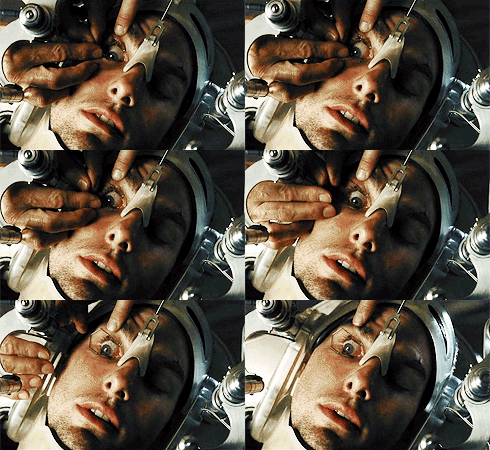
So, in summary
- Bots are still thought of as pull-string toys.
- Bots, in how they actually present themselves, are still pull-string toys.
- Bots actually do solve problems today. Namely, they make changing interfaces unnecessary and bring useful features into empty conversational interfaces you are already in.
- Actually, I wouldn’t call these bots. But it is what it is.
- Bots will become useful in the future.
- Bots will have identities like humans, but wont try to be humans. The identities will be their own.
- As such, we will demand human etiquette and transparency from them, even though their intentions may ultimately be covert (as the data collection you are not privy to happens today)
- They would never, ever, ever vote for Donald Trump.